PEOPLE LIKE YOU ARE SPEAKING UP FOR THEIR HEALTH
Walking to the train station, a simple five-minute walk away and two flights of stairs seemed like I was walking a mile. I was struggling as a new mom at the same time. So I was overwhelmed by all the challenges because of my health. My name is Eileen and I live with rheumatoid arthritis. When I was about twenty four years old, I started to experience pain in my hands, my feet, my ankles and my knees, but it was after the birth of my son when I was twenty six. I could tell something was really wrong. Before, I would be able to excel at my job as an esthetician. But now any pressure of my hands was excruciating. I found myself in the back room crying because of the pain. I was eventually diagnosed at twenty nine when I finally asked my family doctor to test me for rheumatoid arthritis, given my family history of it. My aunt, who also suffered from the same illness, passed away that same week I was diagnosed. So I didn't really have anyone to turn to and I didn't know if that was going to be my fate. Rheumatoid arthritis is an inflammatory type of arthritis. Because of problems within your immune system, this immune system starts building antibodies against your joints, causing inflammation in those joints. The main symptoms of rheumatoid arthritis are pain, especially in the small joints of hands and feet. Stiffness, you have difficulty bending your joints and you have problems functioning. The treatment journey for rheumatoid arthritis can be quite the challenging one, because you have to go through quite a few different medications to find the right one that works for you.
A lot of the treatments that have really helped me with my rheumatoid arthritis have included seeing a physiotherapist an occupational therapist, a clinical social worker. Even speaking to a naturopath at a dietitian can help you understand ways to lower your inflammation. My quality of life has significantly improved. I can go to the gym five times a week now. I can be more of the mom that I want to be. And I can just get on with daily life a little bit easier now. The goal of rheumatoid arthritis treatment is to get rid of the actual disease. So we want this patient to get to either remission, which is no disease activity at all, or low disease activity. I think it's very important for patients who start having symptoms to seek medical attention. This impression that it arthritis and there's nothing that can be done against it is totally false. There's so many things that we can do to treat rheumatoid arthritis nowadays that we are always able to find the best treatment for each and every patient. Other patients would be their own advocates by educating themselves about rheumatoid arthritis, the treatments available and having a real conversation with their doctor about what's best for them. The advice that I would give to somebody with rheumatoid arthritis is to know that they're not alone in how they are feeling, realize that their treatment journey isn't going to be easy. But when they find that light at the end of the tunnel, it can make all the difference in their life. I never thought I would be able to walk the entire seawall in Vancouver and now I can.
Rheumatoid arthritis can strike at any age and it can ravage a body unless treated early and effectively.
Eileen Davidson, a single mother living in Vancouver, feared she was going to lose everything to arthritis — in her twenties. That's probably about five decades younger than the image you reflexively conjure of an arthritis patient, but there are over 100 different types of arthritis that affect millions of Canadians of all ages.
Rheumatoid arthritis (RA), which Eileen has, is an autoimmune disorder that can present suddenly and early in life, affecting joints and organs throughout the body. Roughly 300,000 Canadians, mostly women, live with this debilitating condition which can make normal daily life essentially impossible without treatment.
Eileen started experiencing the first symptoms — pain in her hands and feet — at age 24, which she attributed to her active career as an esthetician. But when her son was born two years later, everything changed. "The pain went to extreme levels I’d never experienced before and other symptoms showed up, like incredible fatigue," Eileen recalls. "I couldn't get out of bed. I couldn't function. And I seemed to constantly have a cold. I'd just gone through the stress of a pregnancy and a C-section birth, so I figured that my body needed time to heal. But things just kept getting worse."
The bleak portrait of a world without effective RA treatment
As a chronic immune condition, RA creates many stories like Eileen's. People minimize and try to tough out their early symptoms as their own bodies continue to progressively attack themselves. "Your immune system is supposed to protect you from outside aggressions such as infections, but in RA there’s a problem with the immune system in that it doesn’t recognize your joints as being yours," explains Dr. Denis Choquette, a rheumatologist at the Rheumatology Institute of Montreal. "It’s as if they were foreign, a stranger. So your immune system starts building antibodies against your joints."
The past two decades have brought substantial advancements in treatment for RA but too many patients still suffer in silence, not knowing that there’s the potential for relief. "When I started practicing, before the year 2000, we had very few options to treat patients with RA," says Dr. Choquette. "Today, we have immunosuppressive therapy and we also have biologic treatments that have been designed precisely to treat the cause of RA. Since we started using these treatments, we can usually restore RA patients’ quality of life, especially when the disease is diagnosed early."
Eileen knew firsthand what life with RA was like before modern therapeutic advancements, as she had seen her own aunt slowly deteriorate from its effects. "My aunt ended up passing away the same week I was diagnosed," Eileen says. "By the time she passed, she was in a wheelchair, her hands were deformed, and she'd had multiple surgeries. I was terrified that her fate was going to be my fate."
New treatment options only help when the right patients receive them at the right time
When patients fail to speak early and openly with their doctors about their full range of symptoms, many become stuck on a path of progressive disability, despite the new therapeutic options available, such as biologics.
Through early intervention, persistence, and transparency with health care providers about not only symptoms but recovery goals, it's possible to achieve low disease activity or even remission. Unfortunately, even as the number of treatment options continues to grow, roughly 70 percent of RA patients currently on treatment have not yet achieved remission. It can take time and tenacity to find the right therapy with the best outcomes.
"It's very important for us as rheumatologists to see patients referred early by their family doctors so they can start treatment early," reiterates Dr. Choquette. "There are so many things that we can do to treat RA nowadays and to find the best treatment for each and every patient."
Eileen was passionate about finding the solution that best fit her specific needs and disease not only for her own sake but also for the sake of her son. "After I was diagnosed, I really began to educate myself, reach out for the help I needed, and advocate for myself," says Eileen, who now has a popular blog and social media presence focused on chronic disease advocacy. "Being your own advocate is one of the strongest ways to fight your disease. It's how you can find the answers you need."
The fight for remission is worth it
Eileen set her goals, communicated them, and relentlessly pursued them. She endured the side effects of multiple inappropriate medications before finding the right one, in her case a modern biologic. She started a new exercise regime and radically changed her diet. She also enlisted the help of a broad health care team across many disciplines.
It's been a lot of work, but the difference is profound. Today, she’s in the best shape she's ever been and is on a medication regimen that works for her. "When I was in the deepest flare, I struggled to just walk around the grocery store or walk five minutes to the train station," says Eileen. "Going up stairs was excruciating. Every joint in my legs and hips hurt. Now I'm in the gym on the treadmill or the elliptical five days a week and I get in around 10,000 steps a day."
Eileen has her life back, and her son Jacob, now seven years old, has a parent not incapacitated by disease. To bring this sort of success to every RA patient in Canada, it’s critical that anyone with symptoms follow in Eileen's footsteps through an open and honest dialogue with their health care team, beginning as soon as possible.
D.F. McCourt
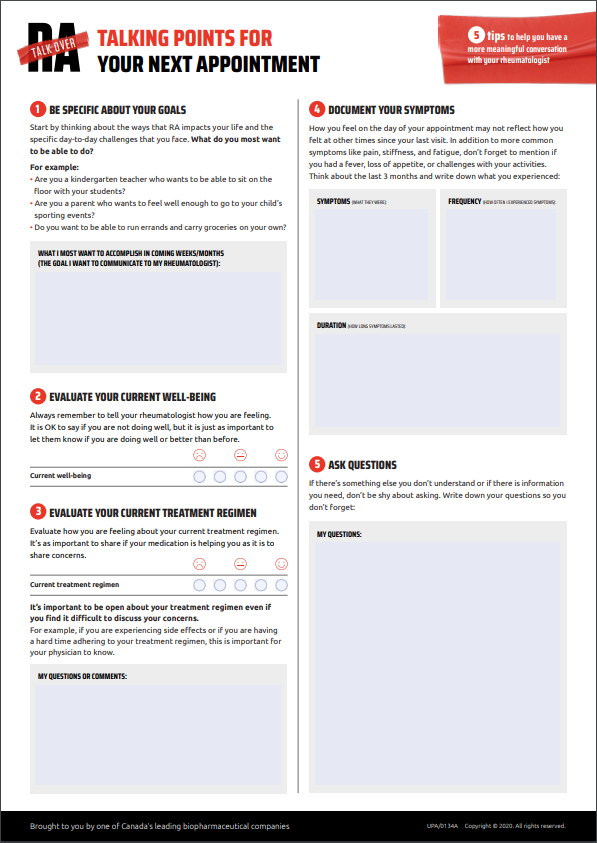
To download the Discussion Guide in other languages, please click here.